
Prepared and distributed by the Wisconsin Interoperability Council and NPSBN Subcommittee in cooperation with the First Responder Network Authority
FINAL | November 2019
*NOTE: This document only applies to primary FirstNet subscribers with FirstNet devices that are equipped with a black FirstNet SIM card
Introduction | What is FirstNet?
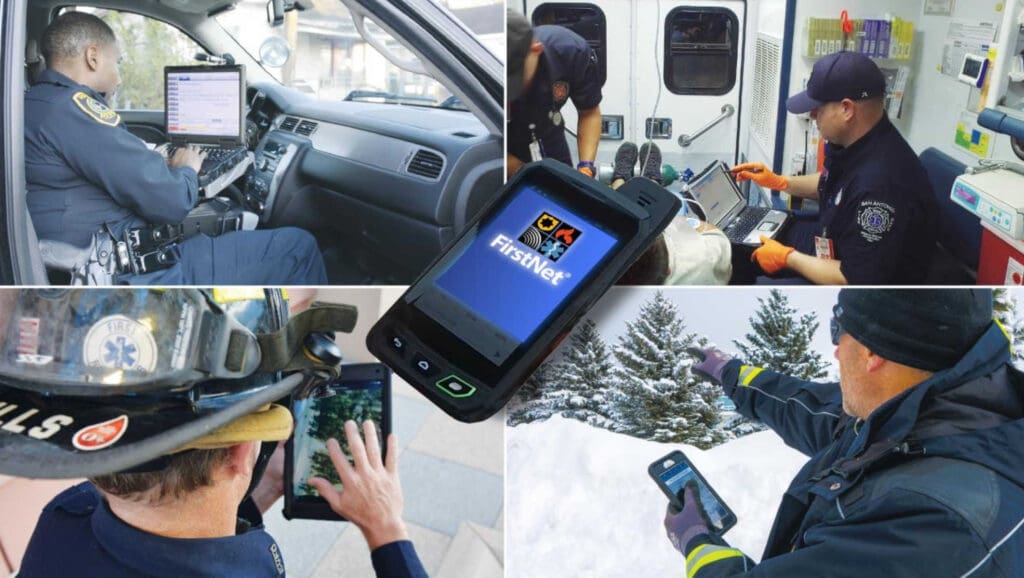
FirstNet is the dedicated public safety broadband network, established through a partnership with the First Responder Network Authority (FirstNet Authority) and AT&T. Authorized by Congress in 2012, FirstNet Authority’s mission is to develop, build and operate the nationwide, broadband network that equips first responders to save lives and protect U.S. communities.
The 25-year public-partnership will put ground-breaking networking tools in the hands of public safety personnel in communities throughout the US. The first five years of the partnership will be defined by a five-year build-out, covering rural and urban areas across the nation. The network will continue to be improved by way of network reinvestment, which the FirstNet Authority will manage.
The FirstNet Authority will oversee the contract to ensure it delivers innovation, technology and customer care to public safety through various mechanisms, including subscriber adoption targets, milestone buildouts, disincentive fees and other mechanisms outlined in the contract.
The Network will improve communications, response times and outcomes for first responders from coast-to-coast, in rural and urban areas leading to safer, and more secure communities. The Network will provide first responders with innovation and robust capacity so they can take advantage of advanced technologies, tools and services during emergencies, such as:
- Applications that allow first responders to reliably share videos, text messages, photos and other information during incidents in near real-time;
- Advanced capabilities, like camera-equipped connected drones and robots, to deliver images of wildfires, floods or other events;
- Improved location services to help with mapping capabilities during rescue and recovery operations; and
- Wearables that could relay biometric data of a patient to the hospital or alert when a fire fighter is in distress.
What does it mean to have “Priority” on FirstNet?
Priority is a key advantage for public safety users who subscribe to FirstNet because it assures that during times of network congestion, the network will always give access precedence to primary public safety users over consumer network users when distributing finite network resources.
First Priority
Incident Level – Tier 1
- Temporary priority level (24 hours)
- Maximum protection against service disruption
- Same performance/throughput as Primary static levels
Tier 2
- Essential protection against service distruption
Tier 3
- Elevated protection against service disruption
Tier 4
- Default Level
- Suitable for everyday use
- Includes Primary Subscriber Paid/loT
Why is it important for Wisconsin Responders to understand priority?
When a Wisconsin agency decides to adopt FirstNet as its cellular provider, it will be given access to the FirstNet network portal. In the portal, it will have the ability to set a priority tier for each of its users. This document will help FirstNet adopters understand how these tiers work and recommends that in most cases, Wisconsin agencies choose the Tier 4 Default setting in order to leave Tiers 2 and 3 open for future features and services.
Defining Priority Tiers
It is important to understand that ALL FirstNet users receive priority over consumer users AT ALL TIMES. This means that there is no need to change any network setting when an incident causes unexpected network congestion: Responders on FirstNet have voice priority and higher data bandwidth allocation by virtue of the fact that they are primary responders. In fact, responders on FirstNet are prioritized in such a way that consumer traffic could even by preempted if needed (aside from 9-1-1 calls), in order to allow responders on FirstNet access to the network for their lifesaving communications. This requires no manual intervention.
4 Priority Tiers for Primary Responders
Tier 1: Incident Level
Responders who have been raised to Incident Level temporary have greater access priority than other primary users while they are in an uplifted status
Tier 2
Tier 3
Tier 4
?
Which Tier is right for my responders for every day use?
Consumer
ALL FirstNet primary responders ALWAYS have greater access priority than consumers
Additionally, during an incident, certain users can be temporarily uplifted to assure that their access to services is prioritized over other public safety users. This is a temporary level which can only be performed by staff who are designated beforehand. Uplift lasts for 24 hours. Responders needing a longer prioritization would need to be uplifted again, as necessary. But, to reiterate, uplift is not necessary to gain priority over consumer users.
Q: When should a primary user be uplifted over other primary users?
A: When the communications to a specific function/team has inordinate importance to the incident response.
Example:
- Local university identifies a potential bomb on campus, calls 9-1-1
- Law enforcement, SWAT and Fire Services are dispatched along with EMS in case of detonation.
- Bomb Tech teams use video connections to collaborate on technical aspects of the bomb.
- In this circumstance, the Bomb Team is the most significant function within the incident and an abundance of caution should be taken to preserve their communications even against an unlikely network failure.
- Therefore, Bomb Team is uplifted to priority 1 until the bomb is neutralized while other primary users remain at priority 4.
Tiers 2, 3 and 4 are additional levels of priority that can be statically assigned – meaning that this is the user’s designated priority assignment unless manually changed. The current recommendation of the IC is to designate all responders at the default level 4. After discussion with both the FirstNet Authority and their network partner, AT&T, we have determined that there is virtually no benefit for Wisconsin agencies to utilize Tiers 2 and 3 at this time. Additionally, future public safety capabilities under development may make it advantageous to keep these levels in reserve and doing so could make priority rearrangements later unnecessary.
What does a higher tier assignment provide?
It is important that all users understand that priority is impacted by a number of network functions, such as what cell site the device is connected to, proximity to a cell site, device capabilities, load on network, etc. Many variables exist that dictate the actual network performance that any one user has at any given time. Because all primary public safety users are already prioritized over consumer users, it is important to understand the nuances that distinguish higher tiers among primary users on FirstNet.
Priority has three key components:
- Access to service: Ones ability to connect to the network
- Performance of Service: The amount of throughput/bandwidth available for network services
- Preservation of Service: Maintaining active connection to services when the network is impaired
Neither ‘Access to Service’ nor the ‘Performance of Service’ are impacted by their assigned Priority Tier. All primary FirstNet users are treated the same in these categories.
The advantage of one tier over another only matters for preservation of service – a rare situation which occurs when the network is too overloaded to function properly and must shed traffic to stabilize itself.
Consumers will always be shed before any FirstNet primary user is impacted and doing so would –except in the rarest of conditions — will allow the network to stabilize itself and continue to function for all responders. In those rare times when public safety traffic alone threatens to overwhelm the network, the network would shed tier 4 users first followed by 3, 2 and, finally, 1.
Assigning a higher tier:
- Will not provide an advantage over other responders for getting on the network
- Will not provide greater throughput or increased network speed versus other responders
- Will not provide an overall better user experience
Why is the Default Tier 4 best for all users?
FirstNet is in its infancy. Today (Q4 2019), there are limited users on the network so contention among public safety users is very rare. In the future, as public safety continues to adopt FirstNet, this will no doubt change. But, importantly here in Wisconsin, given the amount of spectrum available on the FirstNet network and the number of Wisconsin responders on the network, it should be extremely rare that public safety will overwhelm the available resources in the initial moments of any incident. Large developing incidents (such as a tornado or an interstate vehicle accident) would allow time for incident level uplift to be implemented if necessary to distinguish between users.
FirstNet is also in its infancy when you consider the services offered. Over time, Mission Critical Services such as Mission Critical Push-to-Talk and other applications will change the implementation of priority. Priority levels will need to be used to assure that these life-and-death capabilities are managed properly. Keeping a clean slate on priority setting now will make later changes less complex.
Finally, FirstNet plans to offer applications-based priority prior by 2022. This will allow some applications to be prioritized over others based on criteria such as incident type, user, etc.
For example, imaging video from an EMS unit might take precedence over some other kinds of video. As additional priority-based services are operationalized, it may be necessary to reconsider the relative prioritization of users and the IC will take an active role in making recommendations at that time.
Summary
While the IC cannot dictate that any agency set priorities to the Default Level 4, we do feel that it is appropriate to properly inform agencies on the developing nature of FirstNet and the underlying reasons why agencies should operate consistently and with full knowledge of present and future considerations. Acting cooperatively assures the best outcome for responders across the state — both now and in the future. The IC will be continuously monitoring FirstNet priority setting capabilities and the development of additional features in order to inform Wisconsin agencies when concerns arise or other factors require that this recommendation be modified. By working together, we can all ensure that communications resources are consistently utilized properly for the good of all public safety.